

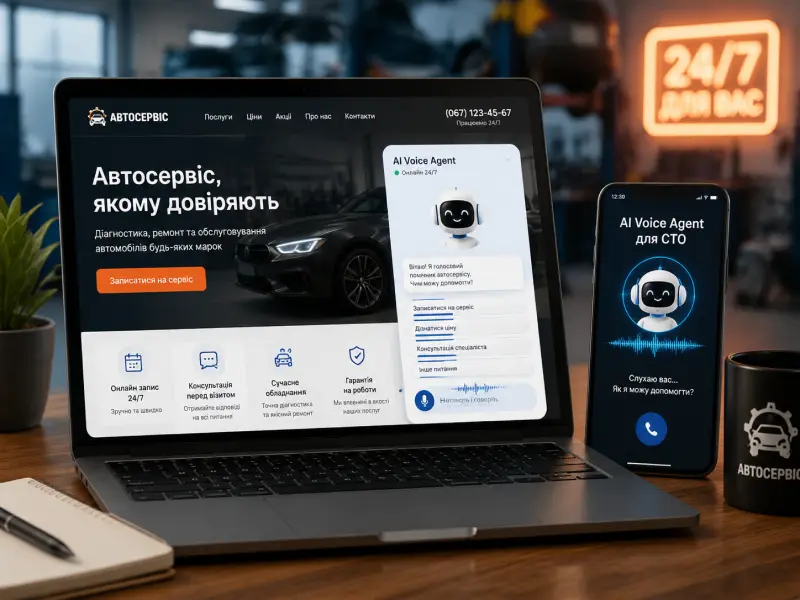
For most auto repair shops, the phone remains one of the main channels for getting new customers. A person calls a service center not just to ask a question — most often they already have a problem with their car and are ready to ask for help.
A customer calls when they need to:
- book a diagnostic;
- urgently repair their car;
- find out the approximate cost of the work;
- check whether the shop handles a specific issue;
- check available time slots;
- get advice before coming in.
But it's exactly at this moment that auto shops often lose potential orders.
The receptionist may be taking in a car from another customer, talking to a mechanic, working with paperwork, or simply unable to answer every call. If a customer doesn't get a quick response, they often call another shop instead.
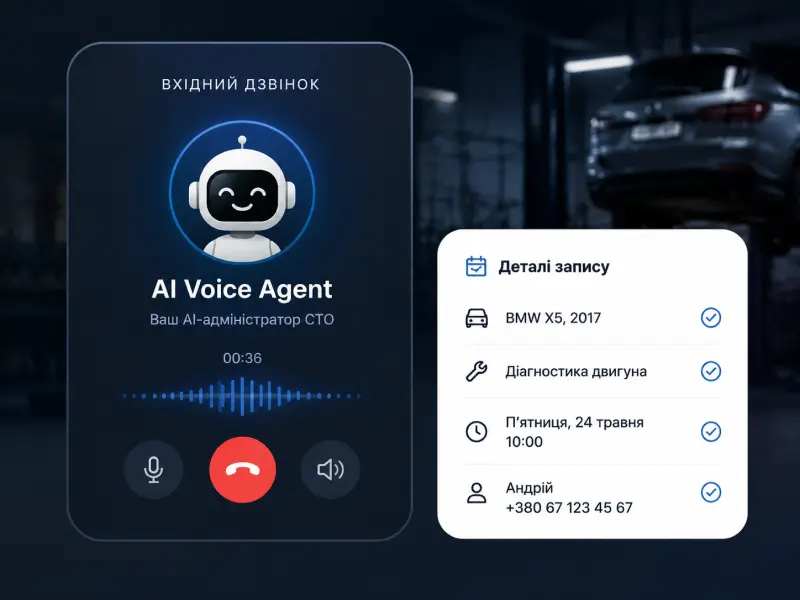
An AI Voice Agent for auto service centers helps solve this problem. It's a voice AI agent that answers calls, talks with customers, gathers information about the vehicle, helps book customers for a service, and works around the clock.
For a shop owner, this isn't just new technology — it's a tool for increasing the number of inquiries, reducing losses from missed calls, and optimizing how the front desk operates.
How much money can an auto shop lose from missed calls?
Many shop owners keep a close eye on spending on advertising, rent, equipment, and salaries, but don't always calculate how much money they lose because the phone isn't being picked up.
Let's look at an example.
An auto shop receives:
- 50 calls a day;
- 15% of inquiries go unanswered;
- the average repair ticket is 5,000 UAH.
As a result:
50 × 15% = 7–8 missed calls a day.
Over a month:
7 × 30 = approximately 210 lost inquiries.
Even if only 10% of them would have become real customers:
21 customers × 5,000 UAH = 105,000 UAH in potential monthly revenue.
Of course, the actual numbers depend on the shop's specialization, the number of inquiries, and the average ticket size. But even a few extra repair jobs a month can fully justify implementing an AI agent.
Why do auto shop customers call more often than they message?
In many industries, customers are shifting to online chats and forms. But for auto service centers, the phone remains one of the most effective communication channels.
The reason is simple: car problems often need a fast answer.
The customer doesn't always know:
- how serious the problem is;
- whether it's safe to keep driving;
- how much the repair will cost;
- how long the work will take.
So they want to talk to a specialist or a receptionist.
That's exactly why a missed call for an auto shop isn't just a failed contact. It's a potential repair job that a competitor might pick up instead.
What is an AI Voice Agent for an auto service center?
An AI Voice Agent is an intelligent voice assistant that performs the functions of a digital receptionist for an auto shop.
Unlike a regular answering machine, the AI holds a live conversation with the customer, understands the request, asks clarifying questions, and helps resolve the issue.
An AI Voice Agent can:
- take incoming calls;
- answer common questions;
- book customers for services;
- clarify vehicle details;
- collect information about the problem;
- confirm and reschedule appointments;
- hand off complex inquiries to a manager.
In effect, it's an AI receptionist that works without breaks and doesn't depend on staff workload.
Which auto shop processes can be automated with an AI Voice Agent?
Booking customers for diagnostics and repairs
The AI agent's main job is to turn a phone inquiry into an actual booking.
A customer can reach out with any of the following:
- needs an engine diagnostic;
- a strange noise has appeared;
- the car has lost power;
- needs to go in for maintenance;
- needs the air conditioning repaired;
- an electrical issue has come up.
The AI clarifies:
- the car's make and model;
- the year it was made;
- the symptoms of the problem;
- a convenient time to come in;
- contact details.
After that, the customer gets a clear next step — a booking at the shop.
An initial consultation before coming in
Many customers call not to book an appointment, but to first understand the situation.
For example:
«Why did the Check Engine light come on?»
«Can I keep driving if the car started jerking?»
«Why did the air conditioning stop cooling?»
The AI can run an initial survey:
- when the problem started;
- under what conditions it shows up;
- whether there are any unusual sounds;
- whether the car's behavior has changed.
This information helps the mechanic get up to speed on the problem faster once the customer arrives.
Answers to frequently asked questions
Auto shop receptionists answer the same requests every day:
- business hours;
- address;
- list of services;
- approximate pricing;
- repair timelines;
- warranty on the work.
An AI Voice Agent can handle such inquiries automatically, without involving an employee.
Reminders and appointment confirmations
The AI can help reduce the number of situations where a customer forgets about a scheduled visit.
It can:
- confirm an appointment;
- remind about the visit date;
- offer to reschedule;
- check whether the visit is still needed.
For an auto shop, this means fewer empty slots in the schedule.
5 real-world use cases for an AI Voice Agent at an auto shop
Scenario 1. Booking a diagnostic
Customer:
«The car has started driving worse, I want to get the engine checked.»
AI:
- clarifies the car model;
- asks about the symptoms;
- offers an available time slot;
- creates the booking.
Scenario 2. An urgent problem
Customer:
«My Check Engine light came on, can I come in today?»
AI:
- clarifies the symptoms;
- determines the urgency;
- offers the nearest available time.
Scenario 3. A pricing inquiry
Customer:
«How much does a brake replacement cost?»
AI:
- explains that the price depends on the car model;
- collects the necessary details;
- offers to book an inspection.
Scenario 4. A question after a repair
Customer:
«There's a new noise after the repair.»
AI:
- logs the inquiry;
- gathers information;
- forwards the question to the responsible specialist.
Scenario 5. A call outside business hours
A customer calls in the evening or on a day off.
AI:
- takes the inquiry;
- records the contact details;
- files a preliminary request.
How does an AI Voice Agent help an auto shop owner earn more?
- More customers without a bigger ad budget
An auto shop may spend significant money on advertising, but if calls aren't being handled, part of that budget is wasted.
The AI helps get more results out of the inquiry flow that's already there.
- Less workload for the receptionist
The receptionist no longer spends hours on the same phone conversations.
The AI takes over:
- common questions;
- booking customers;
- gathering information;
- confirming visits.
And staff can give more attention to the customers who are already at the shop.
- 24/7 operation
A customer might reach out:
- in the evening;
- at night;
- on a day off;
- during holidays.
The AI doesn't hang up the phone and doesn't ask them to call back tomorrow.
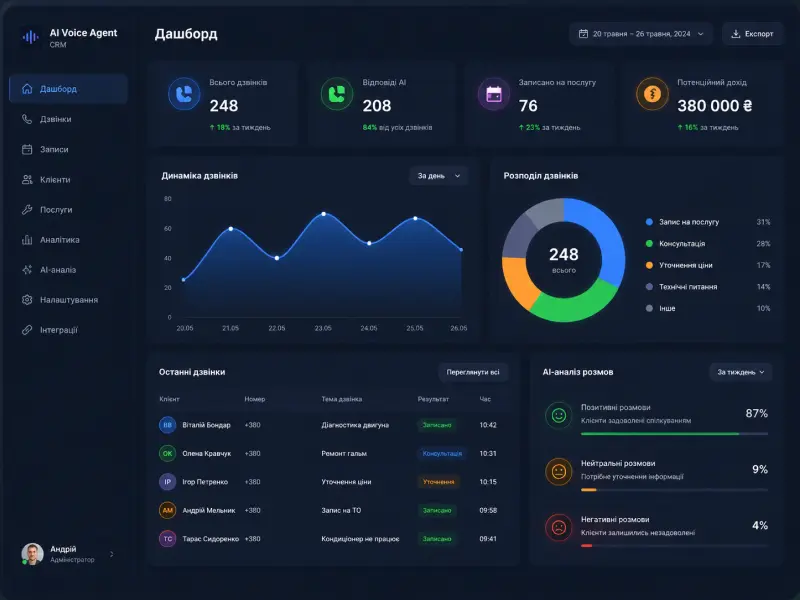
- Quality control over customer interactions
The AI can log:
- the reason for the inquiry;
- vehicle details;
- the outcome of the call;
- the request status.
This helps the owner better understand which services are in demand and where customers are being lost.
Can an AI Voice Agent work with a shop's CRM and booking system?
Yes. For a business, the real value isn't just a voice bot — it's an AI agent integrated into the company's workflows.
The AI can be connected to:
- a CRM system;
- a booking calendar;
- telephony;
- the customer database;
- a request-tracking system.
As a result, no information gets lost, and every inquiry can be handled systematically.
Why does an AI agent for an auto shop need to be built for a specific business?
Every auto shop has its own specifics:
- a different list of services;
- a different specialization;
- a different approach to customers;
- its own booking system.
That's why a generic voice bot doesn't always deliver the result you need.
A good AI Voice Agent needs to take into account:
- the specific shop's services;
- typical customer questions;
- how the receptionist's workflow is structured;
- booking rules;
- the specifics of the target audience.
Building an AI Voice Agent for auto shops with ValuePeak
ValuePeak builds AI agents for businesses that help automate customer communication and streamline sales processes.
For auto service centers, the company can build an AI Voice Agent that:
- takes calls;
- advises customers;
- books diagnostics and repairs;
- collects information about the vehicle;
- integrates into the company's business processes.
The main advantage of a custom solution is that the AI is built not as a generic bot, but as a digital assistant specifically for your auto shop.
If you want to reduce the number of missed calls, get more bookings, and automate customer interactions, reach out to ValuePeak. The team will help build an AI Voice Agent for your business, services, and tasks.
Frequently asked questions
Can an AI Voice Agent replace an auto shop receptionist?
The AI can take over a significant share of routine tasks: answering calls, responding to frequent questions, and booking customers. But complex technical questions can be handed off to a specialist.
Can the AI book a customer for a repair?
Yes. The AI can gather information about the vehicle, identify the customer's need, and create the booking.
Does the AI understand customers' everyday speech?
Yes. Modern AI Voice Agents can hold a natural conversation and understand different ways of phrasing the same request.
Does the AI work on days off and after business hours?
Yes. This is one of the AI's main advantages — the ability to take calls 24/7.
How much does it cost to build an AI Voice Agent for an auto shop?
The cost depends on the complexity of the solution: the number of scenarios, integrations, features, and the specifics of the business.
Is an AI Voice Agent a good fit for a small auto shop?
Yes. For small auto shops, the AI can be a way to handle calls professionally without hiring an additional receptionist.