


The cost of a single request to an AI model can be just a few cents. This leads to a tempting conclusion: if artificial intelligence can do a human's job, integrating it will almost certainly cut costs.
But a business isn't buying tokens or access to a language model. It's buying a working system that needs to receive data, understand context, interact with CRM, telephony, or a website, correctly handle typical situations, and hand off complex requests to employees.
So the question «How much does AI cost?» is framed incorrectly. It's more accurate to ask:
- how much will the entire AI system cost;
- what share of the work it will actually automate;
- how much human labor will remain after launch;
- when the investment will pay off;
- whether the freed-up time will turn into savings or additional revenue.
Only after that can you determine whether AI integration will be worthwhile for your specific business.
Why a Low Token Price Misleads Businesses
A token is a small fragment of text that an AI model receives or generates. The cost of a million tokens in modern models can indeed be low. For example, the official price of Claude Sonnet 5 is $2 per million input tokens and $10 per million output tokens. However, this is just the rate for using the model, not the full cost of an AI solution.
In a real business process, the following are added to the model's price:
- scenario design;
- integration with CRM, ERP, a website, or telephony;
- knowledge base preparation;
- speech recognition and synthesis;
- server infrastructure;
- storage of interaction history;
- testing;
- analytics and logging;
- quality control;
- technical support;
- regular scenario updates;
- employees handling complex requests.
If a vendor only shows you the token price or the cost per minute of conversation, that still tells you nothing about the economics of the entire project.
AI Integration Is an Investment, Not Just a Subscription
Employee salaries fall under regular operating expenses. A company pays them gradually, month by month.
An AI solution usually requires significant upfront investment in:
- process analysis;
- architecture design;
- agent configuration;
- integration with corporate systems;
- testing;
- launch and team training.
At the start, a business doesn't stop paying employees, but it's already paying for the development of the AI system. By the time of full launch, and sometimes even longer, the company is effectively financing both options at once.
That's exactly why a cheaper unit cost doesn't necessarily mean a fast payback.
What Makes Up the Full Cost of an AI Solution
For an objective calculation, it's worth using the TCO metric — total cost of ownership.
One-time costs
Initial investment may include:
- auditing and describing business processes;
- developing the AI agent's logic;
- preparing prompts and scenarios;
- connecting CRM, a website, email, or telephony;
- migrating and structuring data;
- configuring roles and access;
- legal and security review;
- testing on real cases;
- employee training.
In complex projects, it's the integration — not the model — that ends up being the largest cost item.
Ongoing costs
After launch, the company continues to pay for:
- tokens;
- phone minutes;
- speech recognition and synthesis;
- cloud infrastructure;
- data storage;
- third-party service licenses;
- system performance monitoring;
- technical support;
- quality control;
- scenario refinement.
A one-time AI setup practically doesn't exist. Products, prices, service rules, CRM structure, and customer behavior all change. Along with them, the AI system needs to be updated.
Residual human labor
Even a good agent doesn't close 100% of operations. Some requests have to be passed to employees because of a non-standard query, an emotional customer reaction, missing data, or a high cost of error.
If 25–30% of requests are escalated to a human, the company can't always mechanically cut staff by 70–75%. You need to account for uneven workload, peak hours, and the need to quickly bring in a specialist.
As a result, a business may not replace an old expense but add a new technological layer on top of it.
How to Calculate the Economics of Implementing AI
It makes sense to run the calculation in five steps.
1. Determine the current cost of the process
Don't rely solely on an employee's salary. You need the full cost of the position:
Full employee cost = gross salary + employer contributions + software + equipment + office expenses + training + management
After that, you need to determine what share of working time is spent specifically on the process being considered for automation.
If an employee costs the company €4,000 a month but spends only 20% of their time on the relevant operation, the current cost of the process is roughly €800, not €4,000.
2. Calculate the real volume of operations
The calculation requires specific figures:
- number of requests;
- number of calls;
- number of documents or letters;
- average duration of an operation;
- seasonal and daily peaks;
- share of repeat contacts.
A small process may be technically simple to automate but lack enough volume to recover the integration costs.
3. Determine the full cost of the AI system
Simplified formula:
Monthly AI cost = model + infrastructure + third-party services + support + quality control + residual human labor
For a correct comparison, initial costs can be spread over the planned operating period of the system — for example, 24 or 36 months.
4. Account for escalations
If AI passes 25% of requests to a human, you need to count not just the time spent directly handling them. Also important are:
- checking the context;
- re-explaining the problem;
- correcting mistakes;
- customer wait time;
- maintaining a sufficient team for peak load.
5. Calculate the payback point
Basic formula:
Payback period = implementation cost / real monthly financial effect
The key word is «real.» The financial effect can't automatically be equated with the number of hours freed up.
Example: A Voice AI Agent for a Call Center
Let's consider a hypothetical German call center handling 6,000 requests a month. The average call duration is six minutes, for a total monthly volume of 36,000 minutes.
Handling this workload requires roughly five agents. With a gross salary of €2,442, employer contributions, and workplace costs, the total cost of the human team is about €17,268 a month.
For the AI scenario, let's take the following benchmarks:
- voice agent usage — €6,120 a month;
- residual team for 25% of escalations — €6,907;
- support and refinement — €583;
- total monthly costs after launch — €13,611;
- initial integration cost — €35,000.
The monthly difference is about €3,658. Under these conditions, the initial investment pays back around the tenth month.
Cumulative costs: agents vs. AI agent
Projected scenario for 6,000 requests a month. The AI costs include €35,000 for integration.
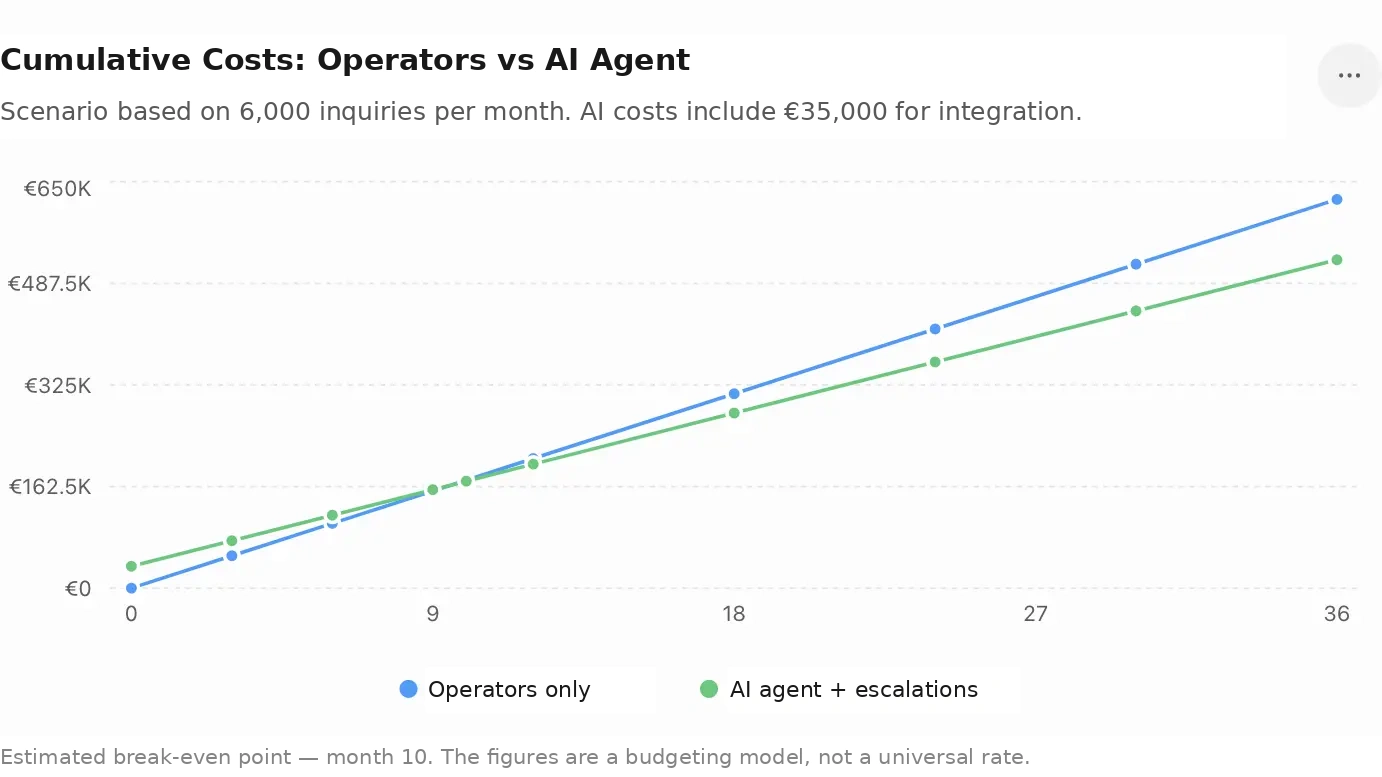
The estimated breakeven point is month 10. The data is a budgeting model, not a universal rate.
This is a scenario where automation makes economic sense because three conditions are met at once:
- a large volume of similar operations;
- a moderate cost of error;
- a real ability to reduce the need for human resources.
The salary benchmark corresponds to the median salary of a call center agent in Germany — about €29,300 gross per year.
At the same time, in a country with lower labor costs, the same agent may take much longer to pay off. The technology stays the same, but the economics are different.
Example: An AI Assistant for Email
Another scenario is an agent that analyzes incoming emails, drafts responses, and creates tasks.
Suppose an executive assistant costs the company €4,387 a month and spends 25% of their working time on email. This process accounts for roughly €1,097 in monthly costs.
The AI agent processes 2,520 emails a month:
- tokens cost about €121;
- amortization of a €9,000 implementation over two years — €375;
- total monthly cost of the agent — approximately €496.
At first glance, the difference is €601 a month. But the assistant can't be let go, since email work takes up only a quarter of their time. The rest of their responsibilities — coordination, communication, escalations, and decision-making — remain.
So €601 isn't automatic savings — it's a monetary estimate of the time freed up.
If only 30% of that time is redirected toward actions that generate additional revenue, the real financial effect would be around €180 a month.
Calculation of monthly email-processing costs for the assistant vs. the AI agent.
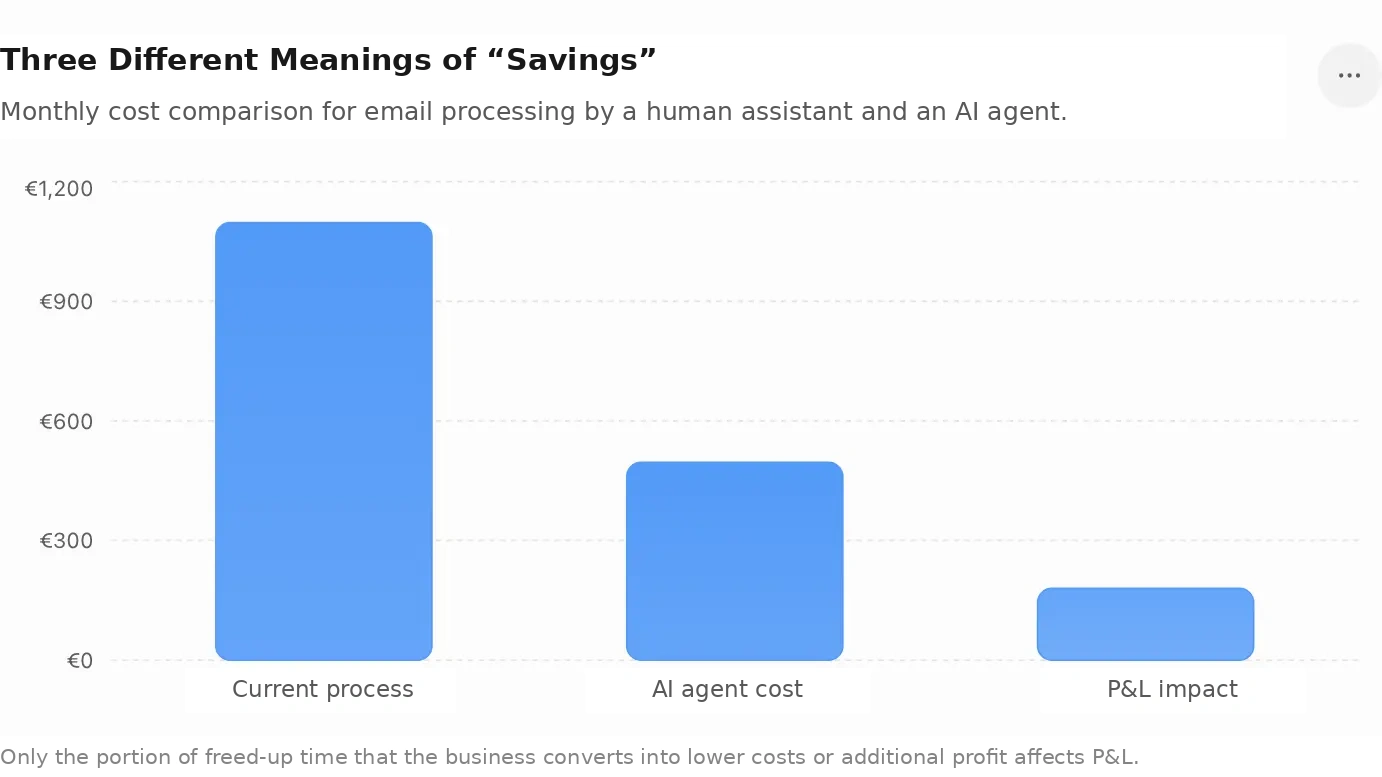
Only the portion of freed-up time that the business has converted into lower costs or additional profit makes it into the P&L.
With a financial effect of €180 a month, a €9,000 integration would take roughly 50 months to pay off.
Technically, the project is a success: the agent works, emails get processed, time is freed up. But its financial efficiency remains questionable.
Freed-Up Time Doesn't Equal Money Saved
This is one of the main mistakes in AI automation calculations.
If a system saves an employee 40 hours a month, a report can show a significant productivity increase. Yet nothing changes in the company's financial results if:
- the salary stays the same;
- staffing isn't optimized;
- production or sales volume doesn't grow;
- the employee doesn't take on other useful tasks;
- service speed doesn't affect conversion.
Before the project even launches, the business should determine where the freed-up time will go.
For example, a manager could use it for repeat contacts with leads, personalized offers, or working with key clients. Then the effect can be measured through additional sales.
If there's no specific plan, automation may still improve employee comfort, process speed, or customer experience. These are valuable results too, but they shouldn't be called direct savings.
Hidden Costs That Are Often Overlooked
Quality control
Someone has to review a sample of dialogues, analyze errors, and monitor compliance with scenarios. This is ongoing work, not a function that disappears forever after launch.
Repeat contacts
If the AI misunderstood the customer, they might write or call again. Then the business pays for the first contact, the repeat contact, and the work of the person who fixes the situation.
Lower conversion
Even a small drop in conversion can wipe out all the operational savings. This is especially risky in sales, where one lost high-value contract can cost more than a month's worth of savings on handling requests.
Deteriorating customer experience
After launch, you need to track:
- the share of successfully resolved requests;
- the number of repeat contacts;
- service duration;
- the escalation rate;
- customer satisfaction;
- conversion to the next stage;
- the number of abandoned dialogues.
Data protection and GDPR
For companies in Germany and other EU countries, it's important to account for personal data processing, record storage, DPA agreements, access rights, and server locations. This creates additional legal and technical costs.
Vendor dependency
Switching to another platform may require re-integration, data migration, and rewriting scenarios. That's why the risk of vendor lock-in needs to be assessed as early as the architecture selection stage.
What to Automate and What to Leave to People
Two characteristics help you preliminarily assess whether automation makes sense: operation volume and the cost of an error.
| Volume and cost of error | Recommendation | Examples |
| High volume, low cost of error | Automate | Order statuses, appointment booking, initial lead qualification, request routing, translation |
| High volume, high cost of error | AI assists, a human decides | Financial recommendations, legal opinions, complex consultations, approval of significant discounts |
| Low volume, high cost of error | Don't fully automate | Negotiations, retaining a key client, HR decisions, crisis communications |
| Low volume, low cost of error | Check economic feasibility | Rare, simple tasks where integration may cost more than doing it manually |
The best candidates are repetitive, high-volume operations with a relatively low cost of error. In such processes, the initial costs are spread over a significant number of operations, and any individual mistake can be fixed quickly.
What Metrics to Establish Before Starting a Project
Before integrating AI, it's worth locking in some baseline metrics:
- the full current cost of the process;
- the number of operations per month;
- average processing time;
- the cost of a single operation;
- conversion rate;
- error rate;
- share of repeat contacts;
- customer satisfaction level;
- the required number of employees;
- revenue or margin generated by the process.
After launch, these same metrics need to be measured again. Without a baseline for comparison, it's impossible to prove that AI actually created an economic effect.
Three Questions to Ask Before Integrating AI
- How much does the work we want to automate actually cost?
You need to calculate not the nominal salary, but the full cost to the employer — and only the portion of it that applies to the specific process.
- Is the volume of operations sufficient for payback?
Even very cheap AI won't recoup integration costs if there aren't enough operations. First check the volume, then the technical feasibility.
- What will happen to the freed-up time or budget?
You need a specific answer: which expense the company will cut, what additional work the team will take on, or what revenue it plans to generate. It's also a good idea to identify who is responsible for delivering on that effect.
If there's no answer to the third question, the project isn't necessarily bad. It might be an investment in training, innovation, service speed, or customer experience. But then it shouldn't be justified by cost reduction.
How to Tell Whether AI Will Pay Off in Your Business
AI can indeed be significantly cheaper than manual labor — especially when it comes to thousands of standard requests, round-the-clock service, lead qualification, working with large volumes of data, or automating repetitive processes.
However, the cost of tokens is only one part of the budget, and often the smallest one. The real economics depend on integration costs, operation volume, escalation rate, the cost of error, and the business's ability to turn automation into a measurable financial outcome.

That's why implementing AI should start not with choosing a model or demoing a chatbot, but with a process audit and an economic calculation.
As part of AI Business Consulting, the ValuePeak team analyzes business processes, identifies viable use cases for artificial intelligence, and builds an integration plan. The goal of this approach isn't to implement AI for the sake of a trend, but to find a solution that reduces losses, speeds up the team's work, and has a clear path to payback.
Cheap tokens don't mean cheap AI. But the right process, an honest financial model, and result tracking can turn AI from an experiment into a genuine business asset.